
PAT testing on Construction Sites, for both 230v and 110v electrical equipment
Tools for use on site are generally tested every 3 months, whereas the site office equipment could be less often; we can manage this for you, making your life easier.
If you need to arrange PAT testing for equipment in the site office, for 110v tools for use on the building site or any other devices we can help you, and ensure you have all the necessary compliance paperwork.
Looking for a reliable PAT testing company to test your tools or building site?
- Fixed rates to PAT Test on construction sites
- 110v power tools, extension leads, etc.
- Site office 230v office equipment
- Repairs and replacement parts (13a plugs etc) included in the price
- Messy cables tidied and re-organised as we go
Reliable, efficient, PAT testing on Construction Sites for tools and equipment
Due to the rules we can’t go into the hard-hat areas of the site, which is actually a sensible approach as trying to inspect extension leads whilst they’re wrapped around concrete stairs and rooms, is a difficult task.
We can however operate in the site office, stores, canteen etc so as long as kit can be brought there we’re good to go. We work on sites for many different construction companies, and this usually works perfectly fine.
Assuming you’re ok with that condition, give us a call to arrange your PAT testing – 0191 666 1009.
PAT testing on Construction Sites
PAT testing 110v equipment is very important as it reduces the chances of an accident on site.
If you need 110v equipment PAT testing use the contact form to get in touch, or read on for more information.
We provide testing of fixed and portable electrical appliances on building sites and for equipment to be used on sites; we will come to the site, your home, office, etc to do the testing.
Information about PAT testing on building sites
Why do we use 110 volts on site rather than 230 volt?
If you are working on a formal building site than you are are going to need to use 110 volt equipment if operating off mains power; this is standard practice on UK sites and is often a pre-requisite for the insurance of the site.
The Health and Safety Executive advise that tools, plugs and cable designed for domestic use are not suitable for site conditions. They further advise that site workers should use cordless tools where possible, or those that operate from an 110v (CTE) centre-tapped transformer so that the maximum voltage does not exceed 55v.
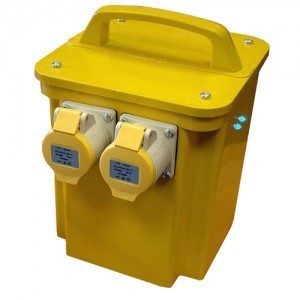
110v site transformers are “centre tapped“; or dual phase. What this means is the 110 volts is actually reduced further to 55 volts x 2. This much lower voltage and current is much safer to use, and it is unlikely to cause you major harm if you accidentally touched a live wire.
How often should 110v tools be PAT tested?
Most sites will have onsite generators with 110v sockets attached to them for use by workers, however it is recommended that you have your own transformer, which should be PAT tested every 3 months whilst in use on site. Transformers convert the 240 volt current to 110 volt and then split that current into at least 2 outlets, to connect other tools; which should also be maintained to safety standards through user checks, formal visual inspections and 3-monthly PAT tests.
PAT testing 110v equipment is very important as it reduces the chances of an accident on site.
Of course 3-monthly is just a guide, and you may have done your own risk assessment that suggests a different frequency, which is fine too.
The best way to do the testing safely
For inspections of electrical equipment on building sites we recommend all equipment is brought to one convenient location, ideally outside the ‘hard hat’ area, so as to reduce the strain on the site insurance and reduce the risk of accident, but also as the best method to ensure all equipment is tested, and something in use on site isn’t missed.
We have experience working on sites, and full PPE, although our insurance doesn’t cover us to operate in hard hat areas, yours probably doesn’t either, so we find the safest method is for you to place all the equipment to be tested in the office areas, or canteen, stores etc where we can test them and do any repairs.
#Top Tip
When you’re using your power tool on site does it seem underpowered? Chances are you’re using a long extension cable. You need a shorter one – the further you are from the actual power source the more likely the power to your tool will reduce. To solve this problem you need to use a shorter lead, or get a battery operated alternative.
The 4 Most asked questions about PAT testing
What’s involved in the PAT test?
PAT testing is farily inobtrusive, and when we work together minimal disruption is guarenteed. We do need to turn equipment off and unplug it to test it but the process is quite quick, so not much downtime. We do repairs as we come across them, so you don’t need to worry about delays due to faults, and every test produces results that are recorded into a fully compliant report which documents every device tested, maintenance and the device location in your premises.
Is PAT testing a legal requirement?
You are legally required to maintain safe electrical equipment for continued use and to prevent danger occuring. In the event of an accident occuring, for an investigation you need to provide evidence that your devices were safe, and that you have done everything you can to ensure this. Regular Portable Appliance Testing (PAT) finds faults and fixes them, ensuring dangers are prevented, and the accompanying report ensures your compliance.
How often should PAT testing be done?
PAT testing should be repeated as often as is necessary to prevent danger occuring. A risk assessment is a good way to work out the risks, which help to determine appropriate frequency. We can also guide you based on our vast experience. Typically, site managers opt for annual PAT tests. With DRA PAT Testing we put you in our reminder system, so when tests are due again we contact you to arrange a retest date.
Do new electrical devices require PAT testing?
Assuming you purchased the new appliances from a reputable source, they do not usually require PAT testing immediately, and should be ok to wait until your next scheduled test assuming that is within 12 months of purchase. We do however recommend that the device be visually inspected before use. However, if you are in doubt at all, get it tested, for peace of mind.