Electric Heater Safety – Why you should not plug heaters into extension leads
Electric Heater Safety Tips
We cannot stress the importance of this enough – please, please, please do not, ever, plug electric heaters (of any kind) into extension leads.
Please only plug heaters directly into the mains sockets. And please don’t leave heaters on permanently, turn them off.
If your room isn’t warm enough consider a more efficient permanent option, rather than a portable heater.
Portable electric heaters are widely used in offices, workshops, schools and temporary workspaces, particularly during colder months. They are convenient, inexpensive and provide quick warmth — but they also place a significant demand on an electrical system.
One of the most common electrical safety issues we come across during PAT testing is the use of electric heaters plugged into extension leads or multi-way adapters. While it may seem harmless, this is one of the easiest ways to create an overheating risk, especially in busy workplaces where cables are tucked under desks, coiled up, or left running for long periods.
Electric heaters draw a high current compared to most everyday appliances. Extension leads are often designed for low-power equipment such as computers, phone chargers or monitors — not continuous high-load heating appliances. Even if the extension lead is fused, that fuse is there to protect against major electrical faults, not gradual heat build-up caused by prolonged heavy use.
When a heater is plugged into an extension lead, the lead, plug, and socket connections can become warm over time. If the cable is coiled, covered, or used alongside other high-power devices, the temperature can rise further. This increases the risk of damaged insulation, melting plugs, and in the worst cases, electrical fires.
In this article, we’ll explain why heaters should always be plugged directly into a fixed wall socket, what the real risks are, and what safer alternatives businesses can use to keep staff comfortable without compromising electrical safety.
This article has been updated in 2026.
Why electric heaters are high-risk appliances
Most portable heaters operate at around 2,000 watts (2kW). That is a significant electrical load, particularly when running continuously for hours at a time.
Unlike many office devices that draw small amounts of power intermittently, heaters place a steady demand on the socket, plug and cable connections. Over time, this can cause components to warm up — especially if the connection is not perfect, the extension lead is of poor quality, or multiple devices are sharing the same supply.
This is why heaters are considered one of the most common causes of electrical overheating incidents in workplaces.
Why extension leads can overheat — even when fused
A common misconception is that extension leads are “protected” because they contain a fuse. In reality, the fuse in a plug is designed to protect the cable from serious electrical faults, such as a short circuit or major overload.
What a fuse does not do is prevent gradual overheating at connection points.
Extension leads are particularly vulnerable because:
-
The plug and socket contacts may not be as robust as fixed wall sockets
-
Cheap or heavily used extensions can develop loose internal connections
-
Heat builds up slowly during continuous high-load use
-
Cables are often coiled, covered, or placed under furniture
-
Multiple appliances are frequently connected at once
The danger is not always an immediate trip or fuse blow. Instead, the extension lead may simply get hotter and hotter until plastic begins to soften or melt.
A true example we encountered in Newcastle (October 2021)
This is a real incident that occurred during a PAT testing visit in October 2021.
We had a three-man team working in a busy office and production environment in Newcastle upon Tyne. The business was well run, with good safety standards, friendly staff and knowledgeable engineers — many of whom worked in technical and electrical roles.
We mention this because it shows that even in competent workplaces, unsafe electrical habits can still develop without anyone realising the risk.
The building was a typical industrial unit with high ceilings and limited insulation. Like many such premises, it became very cold in autumn and winter, so portable heaters were being used throughout the site.
In the reception office, staff were using an electric convection heater. The heater had a sealed moulded plug, which always raises concern because the internal wiring cannot be visually checked.
More importantly, the heater was plugged into a cheap four-gang extension lead. This is something we advise against whenever we see it — not because extension leads are inherently dangerous, but because heaters are not suitable appliances to run through them.
The situation became even more concerning when we discovered that this extension lead was plugged into another extension — a coiled cable reel.
Cable reels must always be fully unwound when used. When left coiled, heat cannot dissipate properly, and the cable itself can overheat under load.
In this case, the reel was powering a printer, a franking machine, an extension lead, and a heater. The combined load was excessive.
We advised staff clearly: the heater should only be plugged directly into a wall socket, and the extensions should not be used in this way. Due to limited socket availability in the room, the arrangement had developed over time.
As a precaution, we left the heater unplugged and disconnected the extension lead.
The following day, we were contacted by the business manager to inform us that the guidance had not been followed. The heater had been plugged back into the extension lead.
Shortly afterwards, the extension socket overheated and melted. It was fortunate that no further damage occurred, but the plug was visibly burnt. Technically, it had caught fire — even though no flames were seen.
This is exactly how these incidents happen: not through dramatic electrical faults, but through everyday misuse of high-power appliances.
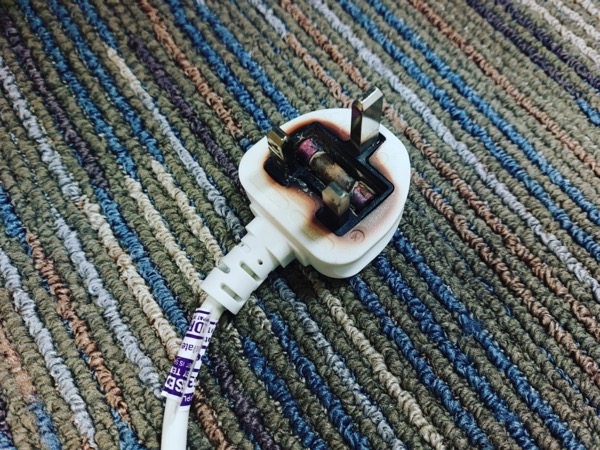
This is the plug of the electric heater, after the incident explained above.
Common unsafe setups we regularly see
This type of risk is not unusual. The most common dangerous arrangements include:
-
Heaters plugged into multi-way adapters under desks
-
Extension leads powering multiple high-load devices
-
Cable reels left coiled while in use
-
Cheap domestic extensions used in commercial settings
-
Daisy-chained extension leads (“extension into extension”)
These setups often develop because there are not enough sockets available, or because staff are trying to solve a comfort issue quickly.
But the electrical risk is real.
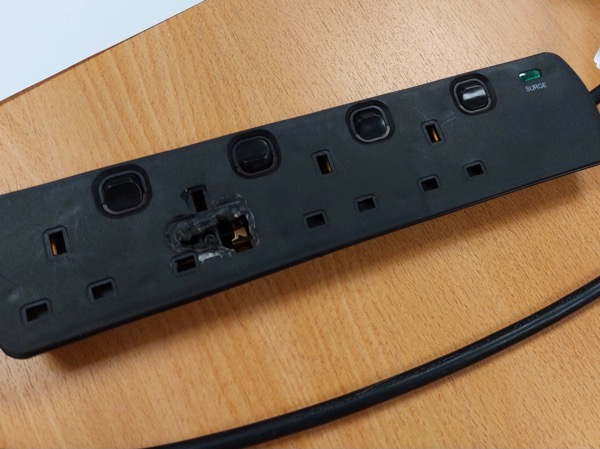
This is what the extension lead looked like after the heater was unplugged.
Safer alternatives for offices and workplaces
If your workplace needs additional heating, the safest options include:
Plugging heaters directly into a fixed wall socket wherever possible.
If there are insufficient sockets in the room, it may be better to install additional outlets rather than relying on extensions.
Where portable heating is essential, staff should be given clear guidance on safe use, and equipment should be checked regularly for signs of overheating, damaged plugs or discoloured sockets.
In many cases, improving insulation or using safer fixed heating solutions is a better long-term answer than relying on portable high-load appliances.
A note for employers and duty holders
Under the Electricity at Work Regulations, employers have a duty to maintain electrical systems in a way that prevents danger.
Portable appliance testing is not just about applying labels — it is also about identifying unsafe practices, overloaded supplies and misuse of equipment that could lead to incidents.
Simple changes in how appliances are used can significantly reduce risk.
Frequently Asked Questions about Heaters and Extension Leads
Can I plug an electric heater into an extension lead if it’s only temporary?
It is strongly recommended not to. Even short-term use can cause overheating, particularly if the heater is running continuously or the extension lead is of poor quality. Electric heaters draw a high current, and extension sockets are not designed for sustained heavy loads.
Does the fuse in an extension lead make it safe to use with a heater?
No. The fuse is designed to protect against major electrical faults, not gradual heat build-up. Overheating often occurs at the plug and socket contacts, and this can happen without the fuse blowing.
Why do extension leads overheat with heaters?
Heaters use far more power than most office equipment. When that load passes through an extension lead, especially one with multiple sockets or loose connections, heat can build up over time. This is made worse if the cable is coiled, covered, or used alongside other appliances.
Is it safe to plug a heater into a cable reel?
Only if the cable reel is fully unwound and the total load is well within its rated capacity. In practice, cable reels are frequently left coiled, which prevents heat from escaping and increases the risk of overheating. For heaters, it is always safer to use a fixed wall socket instead.
What should I do if there aren’t enough wall sockets in the room?
If portable heaters are needed regularly, the safest solution is to have additional wall sockets installed by a qualified electrician. Relying on extension leads for high-power appliances is not a suitable long-term arrangement.
What are the warning signs of overheating plugs or extension leads?
Stop using the equipment immediately if you notice:
-
Warm or hot plugs or sockets
-
Discolouration or scorch marks
-
A smell of burning plastic
-
Buzzing or crackling sounds
-
Loose-fitting plugs
These are signs that the connection may be overheating and could lead to fire.
Is PAT testing enough to prevent heater-related electrical fires?
PAT testing is an important part of electrical safety, but it also needs to be combined with safe appliance use. Many heater risks come from how equipment is plugged in and used day-to-day, which is why good safety guidance and regular inspections matter.
Final reminder
Electric heaters should never be treated like ordinary office equipment. They draw high current, run continuously, and can easily cause overheating when plugged into extension leads, especially cheap ones or those powering multiple devices.
If you are unsure whether your workplace setup is safe, it is always better to ask for advice than to assume.
Electrical safety often comes down to small decisions — and preventing overheating is far easier than dealing with the consequences of fire or equipment damage.
If you are responsible for electrical safety in an office or commercial premises, professional PAT testing can help identify risks like these early and ensure equipment is being used safely.